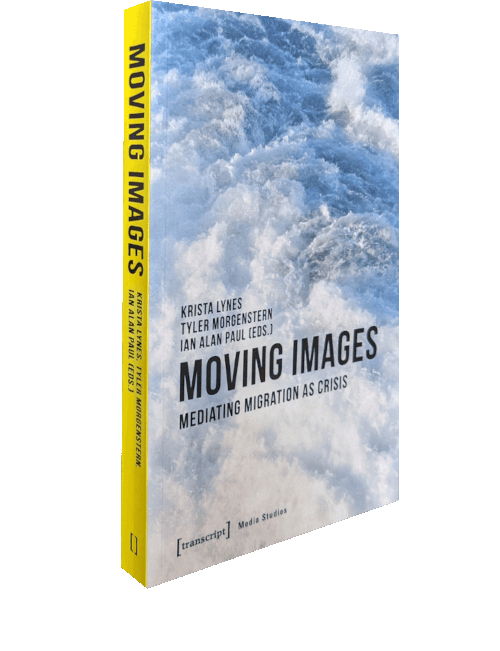
MOVING IMAGES

MEDIATING MIGRATION AS CRISIS

eds. Krista Lynes, Tyler Morgenstern, Ian Alan Paul

In recent years, spectacular images of ruined boats, makeshift border camps, and beaches littered with life vests have done much to consolidate the politics of movement in Europe. Indeed, the mediation of migration as a crisis has worked to shore up various forms of militarized surveillance, humanitarian response, legislative action, and affective investment. Bridging academic inquiry and artistic and activist practice, the essays, documents, and artworks gathered in Moving Images interrogate the mediation of migration and refugeeism in the contemporary European conjuncture, asking how images, discourses, and data are involved in shaping the visions and experience of migration in increasingly global contexts.

The editors of Moving Images stand in solidarity with EMANTES and Solidarity Across Borders. Please consider donating to both organizations.

ONLINE BOOK LAUNCH


TABLE OF CONTENTS

{ download individual chapters below }

​Preface

Sandro Mezzadra

“Labels matter. To speak of a 'migrant crisis' with respect to what happened in Europe in and since the summer of 2015 is not neutral, as readers of this book will soon realize. It has deep political implications and it also requires and nurtures specific forms of visualization—or a specific set of “image operations,” to employ a notion that figures prominently in this book...”
Download The Preface

Through the Black Country

or, The Sources of the Thames Around the Great Shires of Lower England and Down the Severn River to the Atlantic Ocean

Allan deSouza

​“The following extracts are from the expedition diaries of the Zanzibari crypto-ethnologist, Hafeed Sidi Mubarak Mumbai, the fictional great-grandson of the historical figure, Sidi Mubarak Bombay, (1820-1885) ... Bombay became renowned as the most widely traveled person in C19th Africa. Almost a hundred and fifty years later, Mumbai fulfilled his great grandfather Bombay’s unrealized wish to lead an expedition to England...”
Download This Chapter

Introduction

In and Against Crisis

Tyler Morgenstern, Krista Lynes, and Ian Alan Paul

“How might processes of scholarly inquiry track and keep pace with the ephemeral but perpetually catastrophic rhythms of the mediation of 'crisis'? How might we devise tools and positionings responsive to the continual opening up of new spaces of vulnerability and exposure? Such questions are ever more urgent in the light of intensifying and accelerating processes of displacement, detention and deportation in Europe, even as the visual economy of the migrant crisis has shifted once again...”
Download The Introduction

Section One. Moving Media

SeaPath

Zineb Sedira

Section One begins with Zineb Sedira’s SeaPath, an artistic project consisting of a series of images taken from ferry crossings between Algiers and Marseille. They present, as Tyler Morgenstern poetically theorizes in “The Literal, at Sea,” not a document but a turbulent and indeterminate imaging practice, one in which the 'literal is already littoral,'”' severed from reference and set adrift as fleeting bits of form (and foam) on the sea’s surface.

Download This Artwork

The Literal, at Sea

Tyler Morgenstern

“Reference, though discernable, has been reduced to an absolute minimum. In each image, a wake—or is it a wave?—cuts across the frame, a bit of turbulence that, lacking any visible origin, reads as little more than graphical abstraction ... If the photograph aspires to or carries with it the promise of the literal, of registering what is or what has been, here it captures only littoral, the watery recession of tidy edges, discernible causes, and legible itineraries...”
Download This Chapter

A Sensible Politics

Image Operations of Europe’s Refugee Crisis

Bishnupriya Ghosh

“Refugee image cultures are the dangerous supplement to refugee crises. As such, they invite critical opprobrium, sometimes for the unethical sensationalism of particular images and sometimes for the desensitizing effects of image overloads. At first glance, the steady stream of images serves only to numb rather than to incite real-time responsibility toward the migrant waves that seek passage into new territorial enclosures...”
Download This Chapter

Controlling the Crisis

Ian Alan Paul

“If it were possible to ventriloquize power today it would only talk over itself, anxiously announcing that 'the whole of our world is in crisis' while austerely assuring that 'everything is entirely under control.' This contradiction suffuses our present, a historical moment in which elaborate reports on the disintegration of this or that structure or institution double as advertisements for security programs that promise to ever more intensely, impenetrably, and intimately safeguard a seemingly threatened world.”
Download This Chapter

Forensic Oceanography

Tracing Violence Within and Against the Mediterranean Frontier’s Aesthetic Regime

Charles Heller and Lorenzo Pezzani

“Most migrants’ deaths across the Mediterranean frontier have not only occurred at sea, but through the sea, which has been turned into a deadly liquid as a result of the EU’s exclusionary policies which precaritize their crossings. The sea’s 'geopower' has become embedded in a form of killing operating without state actors directly touching migrants’ bodies, in which violence is rather inflicted in a mediated way, through water: it is the liquid element that transmits the violence of state policies to the bodies and lives of migrants.”
Download This Chapter

Reframing the Border

Lonnie van Brummelen and Siebren de Haan

“As cultural producers from Europe, we experience the continent where we live as an ambiguous terrain; we cannot simply identify with it without accepting the consequences of such a positioning ... Its systems are as regional as any other regional configuration of knowledge, but Europe has always understood them as universal and turned them into global designs...”
Download This Chapter

Migrant Images

Thomas Nail

“The twenty-first century is an age of mobility. Enormous numbers of people are on the move today in increasingly unequal ways. More images, too, are on the move. The migrant has become the political figure of our time just as the mobile digital image has become the aesthetic figure of our time. The migrant and the image are part of the same historical primacy of motion and mobility that defines life in the early twenty-first century...”
Download This Chapter

Listing

Thomas Keenan and Sohrab Mohebbi

“Boats list and sink, and their passengers and crew drown, all the time. The forces of nature are often to blame. The phenomenon charted by The List is anything but natural. It results from the deliberate choice of European governments and electorates to restrict legal entry into the EU by those seeking refuge, asylum, or a better life ... The engine that drives The List is the weaponization of the sea, land, and weather in the name of what is cynically called 'deterrence.'”
Download This Chapter

The List

Banu Cennetoğlu

Banu Cennetoğlu’s ongoing project, “The List,” draw from the Amsterdam-based organization UNITED for Intercultural Action’s 'List of Deaths of refugees and migrants due to the restrictive policies of ‘Fortress Europe.’ Collaborating with numerous curators and art institutions, Cennetoğlu has facilitated the publication and exhibition of UNITED’s up-to-date list in multiple languages and formats, from public displays in cities like Amsterdam, Barcelona and Los Angeles to newspaper supplements.
Download This Project

Section Two. Mobile Positions

The Adouaba Project

Abdessamad El Montassir

Section Two begins with Abdessamad El Montassir’s “The Adouaba Project” (2019), which traces and visualizes two communities — the adwaba villages in Mauritania and the tranquilos communities in the hills and forests outside the Moroccan city of Tangiers. In El Montassir’s complex artistic project, these communities constitute a contemporary form of marronage, built by those who have fled conditions of enslavement yet now await the emergence of new routes of passage to an elsewhere and otherwise...
Download This Artwork

“The Adouaba Project”

Tranquilos, Adwaba and Moving Spaces

Krista Lynes and Abdessamad El Montassir

“Marronner enacts a different trajectory of movement, one that undoes the relation between slavery and freedom, that undoes the narrative of movement into freedom, if by freedom one understands moving into the European zone. Marronner cuts the arrogance that collapses freedom and Europe, that reconfirms the metropole as the site of arrival...”
Download This Chapter

Unsanctioned Agency

Risk Profiling, Racialized Masculinity, and the Making of Europe’s “Refugee Crisis”

Veronika Zablotsky

“Western publics continue to be steeped in imageries that position racial others as outside of time (and thus outside the present’s technological affordances). The sight of refugees with smartphones, taking 'selfies' no less, raised eyebrows because it unsettled implicit assumptions about the imagined other of Europe. The millennial subjectivity identified with the quotidian aesthetics of the “selfie” disrupted the phantasy of Western superiority vis-à-vis refugees. Its casual display broke with narrative conventions that construct refugees as objects of humanitarian relief...”
Download This Chapter

The Calais Crisis

Real Refugees Welcome, Migrants “Do Not Come”

Farah Atoui

“The discursive regime of crisis not only implicates the future to act on the present, but it also restructures the past by disappearing the historicity of migration. The narrative of crisis indeed invokes a nostalgic account of a mythical past that was supposedly absent of migration, and that was disrupted by the threat of the migration crisis. The language of crisis therefore forecloses the structural nature of exclusion and exploitation that produces the migrant 'camp' as an ongoing phenomenon...”
Download This Chapter

SOPHIA

The Language of “Trafficking” in the Mediation of Gendered Migration

Krista Lynes

“How to renegotiate a border security operation named after a young Somali child born aboard a German frigate, itself named after a figure of German imperial power? How can we name the willful forgetting that forces these condensations to remain unpacked? And how to do so without reconfirming the language of rights or freedom curtailed by anti-trafficking discourse from the outset?”
Download This Chapter

Solidarity and the Aporia of “We”

Representation and Participation of Refugees in Contemporary Art

Suzana Milevska

“The substantial difference between inclusion and belonging (access to state institutions that secure such equal civic rights as rights to education, visas, residential and work permits, employment, and citizenship), and the symbolic inclusion and short-term participation in art projects is one of the main reasons it is urgent to analyze the political dynamics of participatory art practices that include refugees...”
Download This Chapter

Either You Get it Or You Don’t

A Conversation on LGBTQIA+ Refugees’s #Rockumenta Action

Sophia Zachariadi and Krista Lynes

“It’s interesting to me that many people have their own interpretation of the act we performed; they label it 'anti-racist' (which it is, but in a different manner), 'feminist,' queer ... People are obsessed with the symbolism of the action, which is tiring for me. People ignored the fact that what you had was a vulnerable group of people with completely different political, social, religious or cultural backgrounds; even how they understand their gender and sexual identity is completely different. Most people wanted to see their own fantasy confirmed — their understanding, their position, their angle ... They saw us as a political group. I told most of the allies who came that LGBTQIA+ Refugees Welcome is not a political group; what is political is the experience that these people hold.”
Download This Chapter

#Rockumenta

LGBTQIA+ Refugees in Greece

Section Two ends with documentation of a very differently participatory artistic-activist action by the collective LGBTQIA+ Refugees in Greece, performed on the occasion of Documenta 14’s exhibit in Athens, Greece in 2017.33 The action, which involved a performative “rock-napping” of a public sculpture by the artist, Roger Bernat, meant both to emphasize the instrumentalization and exoticization of queer migrant life, and to foreground the specific vulnerabilities of this community, and the work of the collective.
Download This Document

Afterword

Lies of the Land

Allan deSouza

“Clouds part in revelation: England, a patchwork of fields, each square hemmed neatly by hedges. A quilt of fables rushes up to greet me, of a land of glory and hope, of order and decency, of red letterboxes, of a white woman with a golden crown, of friendly blue bobbies. As they say ... the lie of the land.”
Download The Afterword